



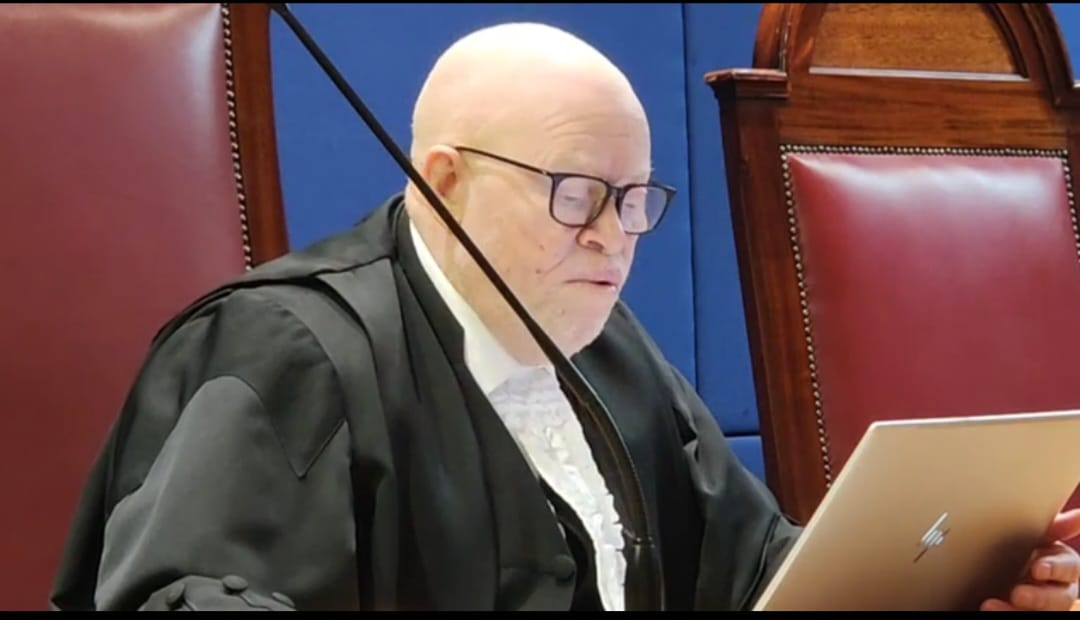
NUL and co-respondents have taken their fight to the Court of Appeal on an urgent basis, seeking to halt High Court proceedings and remove the presiding judge in a case brought by Pro-Vice-Chancellor Professor Kananelo Mosito over the university’s Vice-Chancellor recruitment process.
The National University of Lesotho (NUL) and other respondents in a court case involving the university’s Vice-Chancellor recruitment process have approached the Court of Appeal on an urgent basis seeking to stop proceedings in the High Court and remove the judge handling the matter.
The case was brought by Professor Kananelo Mosito, the current Pro-Vice-Chancellor of NUL and President of the Court of Appeal, who is challenging the university’s decision to begin recruiting a new Vice-Chancellor.
The latest development follows a High Court ruling that it has jurisdiction to hear the matter. The court also dismissed an application by NUL seeking the recusal of the entire High Court from dealing with the case.
Following that ruling, the respondents informed the court that they had filed an urgent application before the Court of Appeal seeking a stay of execution of the order directing that the main case proceed. They are also seeking the recusal of Justice Molefi Makara, who is presiding over the matter.
NUL argues perception of bias
NUL argues that there is a reasonable possibility that judges of the High Court may be perceived as biased because of Professor Mosito’s position as President of the Court of Appeal.
During arguments before the High Court, counsel for NUL, Advocate Mamello Makau, said the application was aimed at protecting public confidence in the independence and impartiality of the judiciary.
She argued that Professor Mosito’s professional relationship with High Court judges could create a perception that judges may not be completely independent when deciding a case involving him.
According to Advocate Makau, the concern is not necessarily whether judges would actually be biased, but whether an informed member of the public could reasonably believe that impartiality might be compromised because of the existing institutional relationship.
She submitted that public confidence in the justice system depends not only on judges being impartial but also on them being seen to be impartial.
The application for recusal was also supported by an affidavit filed by NUL Council Chairman Dr. Khabele Matlosa. In his court papers, Dr. Matlosa stated that the university has a reasonable apprehension that judges of the High Court may find it difficult to adjudicate impartially in a matter involving a colleague who also serves as the head of the country’s highest appellate court.
He argued that judges may be reluctant to make decisions that could place them in conflict with the President of the Court of Appeal. Dr. Matlosa further claimed that Professor Mosito possesses personal characteristics that could potentially intimidate colleagues or influence judicial officers, and alleged that there was a possibility he could attempt to exert pressure on judges hearing the matter.
Mosito disputes any suggestion of influence
Professor Mosito strongly opposed the application. His lawyer, Advocate Dominic Metlae, argued that there was no basis for suggesting that his client could influence High Court judges.
Adv. Metlae told the court that Professor Mosito does not control the work of High Court judges and has no authority over their judicial decisions. He further argued that although High Court judges may sit as acting judges of the Court of Appeal from time to time, this does not place them under the authority of the President of the Court of Appeal.
According to him, judges perform their duties independently and are appointed through constitutional processes overseen by the Chief Justice.
“The fact that judges may serve in different courts does not mean they are subject to the control of the President of the Court of Appeal.”
The allegations made by Dr. Matlosa have been strongly disputed by Professor Mosito.
The core dispute: was recruitment lawful?
At the centre of the dispute is the university’s decision to begin a process to recruit a new Vice-Chancellor while Professor Mosito remains in office as Pro-Vice-Chancellor. Professor Mosito argues that the recruitment exercise is unlawful because it was initiated before a vacancy existed.
According to documents filed before the court, he contends that the process violates Section 16 of the National University of Lesotho Order of 1992, which governs the appointment of a Vice-Chancellor. He maintains that the university acted outside the powers granted by law when it commenced the recruitment exercise before the position became vacant.
The respondents, on the other hand, dispute that interpretation and maintain that the recruitment process was lawful. Their position is that the matter should not proceed before Justice Makara while questions regarding judicial impartiality remain unresolved.
The respondents therefore want the Court of Appeal to intervene and suspend the High Court proceedings pending the outcome of their urgent application.
What happens next
The dispute has attracted significant public interest because it involves one of the country’s most senior judicial figures and the leadership of the National University of Lesotho, the country’s largest institution of higher learning.
The Court of Appeal is expected to determine whether the High Court proceedings should be halted and whether Justice Makara should continue presiding over the matter before the substantive issues can be fully argued.
As the legal battle continues, both sides remain firm in their positions, setting the stage for what is likely to be a closely watched court showdown over university governance, judicial impartiality and the interpretation of the law governing the appointment of a Vice-Chancellor.
Correction: An earlier version of this article, published 24 May 2026, incorrectly identified Professor Kananelo Mosito as Vice-Chancellor of the National University of Lesotho. Professor Mosito is the Pro-Vice-Chancellor. The recruitment process under dispute is therefore not for his successor in that role. The article has been corrected accordingly. The Lesotho Tribune regrets the error.