



Labour · Southern Africa
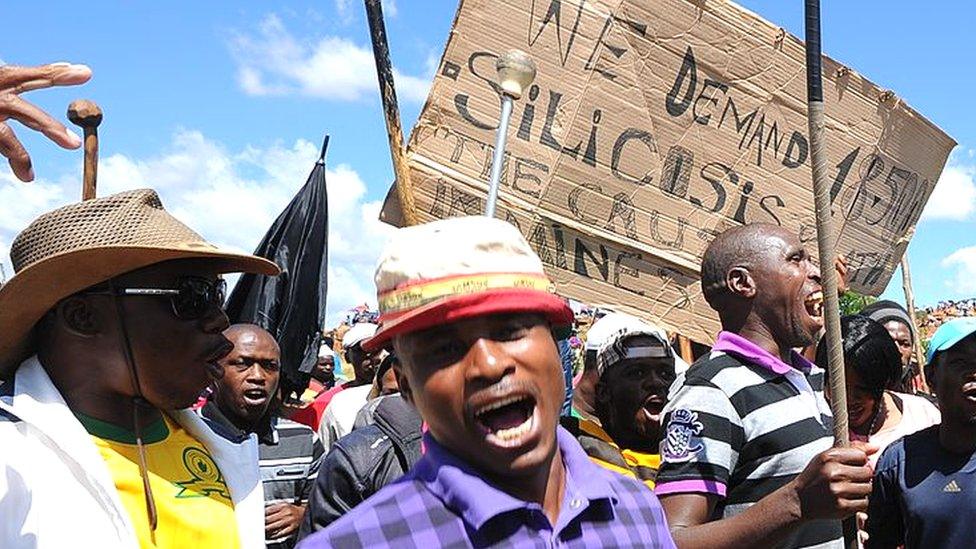
A campaign organisation representing former mineworkers has declared a proposed amendment to the Tshiamiso Trust deed unlawful, warning it would cut thousands of elderly and gravely ill Basotho miners and their widows off from the only compensation they were ever promised.
By Seipati Matobo · Maseru
Thousands of former gold mineworkers face being stripped of their right to compensation under a proposed change to the Tshiamiso Trust, the legal settlement established by South Africa’s gold mining industry to pay out workers who contracted silicosis or tuberculosis underground.
The trustees of the Trust have quietly resolved to adopt Amendment No. 9 to the Trust Deed, which would remove the legal standing of Occupational Diseases in Mines and Works Act certificates, known as ODMWA certificates, as valid grounds for a compensation claim. The amendment requires approval from the Master of the South Gauteng High Court to take effect.
Justice for Miners (JFM), the campaign organisation representing the miners and their dependants, this week declared the proposed change unlawful, immoral, and a betrayal of the very purpose for which the Trust was created. It has written to Ms Beatrice Desiree van Wyk, Master of the South Gauteng High Court in Johannesburg, requesting that she reject the amendment and call the trustees to account.
“How can an MBOD certificate be good enough to end a man’s livelihood, to send him home to die, but not good enough to pay him what he is owed? This is not an administrative adjustment. It is a profound injustice dressed up as a procedural change.” — Bishop Jo Seoka, Chairperson, Justice for Miners
ODMWA certificates are statutory documents issued by the Medical Bureau for Occupational Diseases, a South African government body. They formally certify the presence of silicosis or tuberculosis in a miner. For decades, an ODMWA certificate was legally sufficient to have a miner declared unfit for work and retrenched, often returned to his home country with a disease in his lungs and no income. Under Amendment No. 9, that same certificate would no longer be sufficient to secure the compensation he was owed.
Many of the affected miners are Basotho citizens who migrated to work on South Africa’s gold mines and returned home with occupational diseases and little else. Their beneficiaries are among the most vulnerable people in Southern Africa, men who gave their lungs, and in many cases their lives, to an industry that generated enormous wealth while destroying their health.
For living claimants, the amendment would not merely change a procedure. It would construct a wall. Where an ODMWA certificate once served as sufficient, lawful proof of disease and entitlement, the change would force every living claimant to submit to a new Benefit Medical Examination, requiring them to travel, often over long distances, to designated examination centres.
For men who are elderly, seriously ill, and in many cases living in remote villages in Lesotho, Botswana, Malawi, Eswatini, Zimbabwe or Mozambique, this severely compromises their access to compensation. JFM further warns that Benefit Medical Examinations conducted under the Trust’s own framework have repeatedly produced findings that result in lower awards than what ODMWA certificates already certify, effectively reclassifying miners downward and paying them less than they are legally owed.
The ODMWA certificate was never a loophole. It was the floor. Amendment No. 9 removes that floor entirely.
The situation is, if anything, more catastrophic for the dependants of miners who have already died. A dead man cannot undergo a Benefit Medical Examination. He cannot present himself at a clinic or answer a call centre’s questions. The ODMWA certificate issued in his name is, in many cases, the only credible evidence that survives him: evidence that he was examined, certified, and found to have a qualifying disease. It is the document on which his widow’s entire claim depends.
Remove that certificate from the equation, and widows and dependants are left to reconstruct a medical history from scratch. They are expected to produce death certificates, mine medical records, and employment histories that are near impossible to find, particularly given the poor record keeping by mines and hospitals over decades. Death certificates alone are routinely rejected by the Trust if they do not conform to its specific requirements.
JFM’s legal position is that Amendment No. 9 is unlawful on its face. Section 20.2 of the Trust Deed explicitly prohibits any amendment that adversely affects the rights of eligible claimants, which is precisely what the proposed change does. The organisation has requested that the Master exercise her supervisory jurisdiction under the Trust Property Control Act 57 of 1988 to reject the amendment and, if appropriate, investigate potential maladministration of the Trust.
In parallel, JFM has formally appealed to the Ministers of Health, Mining, and compensation authorities in South Africa, Lesotho, Botswana, Mozambique, Malawi, and Eswatini to write to the Master of the High Court requesting rejection of the amendment. The organisation argues that a substantial proportion of the Trust’s beneficiaries are citizens of these countries, and that their governments have both a moral obligation and a direct interest in ensuring they receive the compensation they are owed.
JFM has requested in-person meetings with government officials in each of these countries to present its case and coordinate a joint intervention before the Master makes any decision on the amendment.
“The Tshiamiso Trust was established to make right a profound historical injustice. The men who built South Africa’s gold mining industry with their bodies deserve the compensation they were promised, not new bureaucratic obstacles designed to frustrate their claims.” — Bishop Jo Seoka
The Tshiamiso Trust was established following a class action settlement in the South African courts, agreed to by the major gold mining companies, to compensate workers who developed silicosis or tuberculosis as a direct result of underground work. Justice for Miners Campaign NPC represents mineworkers and their dependants who are beneficiaries of the Trust.