


Lesotho Tribune — Sentiment Tracker
When asked whether the government could manage a global supply shock, nearly three quarters of Basotho said no. That verdict deserves careful attention.
There is something revealing about how people respond to hypothetical crises. Not the technicalities of geopolitics or the distant calculations of oil markets — but the simpler, more personal question beneath all of it: do you trust your government to protect you?
In the latest Lesotho Tribune Sentiment Tracker, Basotho were asked whether the government could ensure fuel security if a prolonged conflict involving the United States, Israel, and Iran were to disrupt global supply chains. The results are not just decisive. They are stark.
A crisis that has not arrived — but already feels real
The scenario remains hypothetical. Tensions in the Middle East have raised concerns about disruptions to global oil flows, particularly through the Strait of Hormuz. For Lesotho, the risk is indirect but real: the country does not import fuel from the Gulf, but it depends entirely on South African supply chains whose pricing and stability are shaped by global shocks.
What the poll measures is not a technical assessment of those supply routes. It captures public intuition. And that intuition is blunt: if a shock comes, people do not expect the system to hold.
The confidence gap
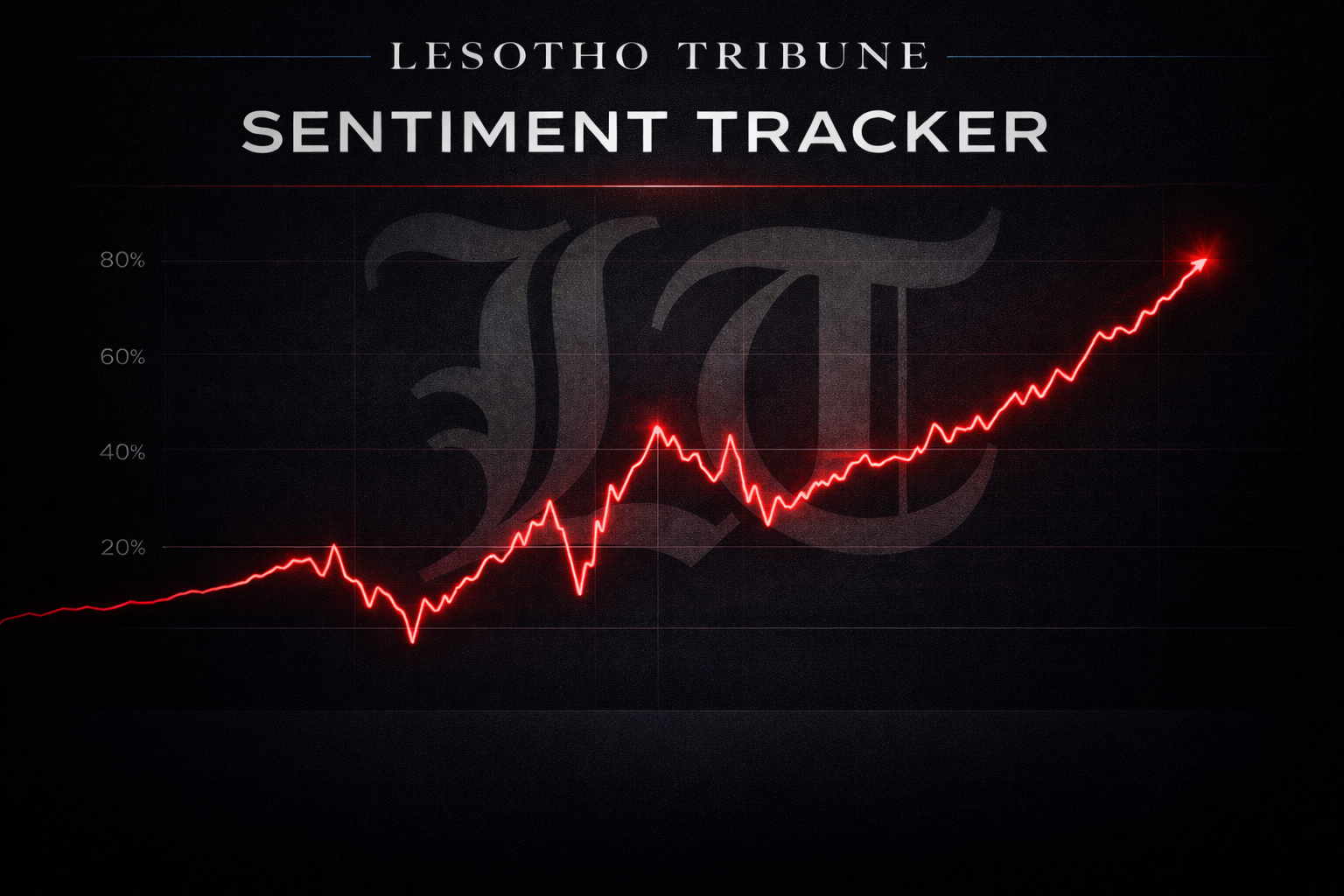
Only 11 percent of respondents expressed full confidence in the government’s ability to manage such a crisis. Even when combined with the five percent who said “somewhat,” the total share willing to extend any degree of confidence reaches just 16 percent.
Confidence is not a soft variable. It is a stabiliser. And right now, it appears to be in short supply.
Lesotho Tribune — Sentiment Tracker
This gap matters in practical terms. In times of crisis, perception shapes behaviour. Businesses that expect shortages begin to stockpile. Transport operators that anticipate price spikes adjust fares in advance. Households that believe supply will tighten change consumption patterns before any shortage actually occurs. These responses can turn a manageable disruption into a self-fulfilling one.
Why the distrust has structural roots
It would be tempting to read this result as reflexive pessimism. But the sentiment reflects real and observable conditions. Lesotho faces a set of structural vulnerabilities that any honest accounting must acknowledge:
- The country does not control its own fuel import infrastructure, relying entirely on South African logistics and pricing mechanisms.
- Strategic fuel reserves — if they exist at the required scale — have not been communicated publicly in any meaningful way.
- There is no visible contingency planning framework for prolonged supply disruptions, at least none accessible to the public.
- Government communication on energy security has been largely absent, leaving citizens to form their own assessments.
In this environment, trust cannot be assumed. It must be built — through transparency, through communication, and through evidence of preparedness. Without these, assumptions fill the vacuum. And assumptions, as the poll demonstrates, are rarely generous.
The undecided ten percent
One in ten respondents said they were not sure. This group is easily overlooked, but it matters. It represents a segment of the population that has not yet formed a settled view — and that means they remain persuadable.
In a different information environment, with credible government communication about reserves, planning, and coordination with South Africa, this group could shift toward confidence. In the current vacuum, the more likely direction is toward deeper scepticism. Silence, from institutions, tends to push uncertainty toward doubt.
This poll is about more than fuel
Energy security is the lens. But what this poll actually measures is something broader: the public’s assessment of the state’s capacity to manage risk, coordinate a response, and communicate under pressure. Fuel is simply the vehicle through which that judgment is expressed.
The verdict, in this snapshot, is uncomfortable. And it arrives before any crisis has materialised — which, in some ways, makes it more significant. When confidence collapses in advance of an emergency, the emergency itself becomes harder to manage.
The question for government
This poll does not demand immediate answers to a scenario that may never fully develop. But it does raise a more fundamental question, one that no amount of technical contingency planning can substitute for:
What would it take for that 74 percent to change its mind?
Because until that question is seriously addressed, the real vulnerability may not lie in the Strait of Hormuz. It may lie in the far shorter distance between the state and the public it is supposed to serve.
You have 1 free article left this month. Create a free account for 15 articles/month.
Create free account