



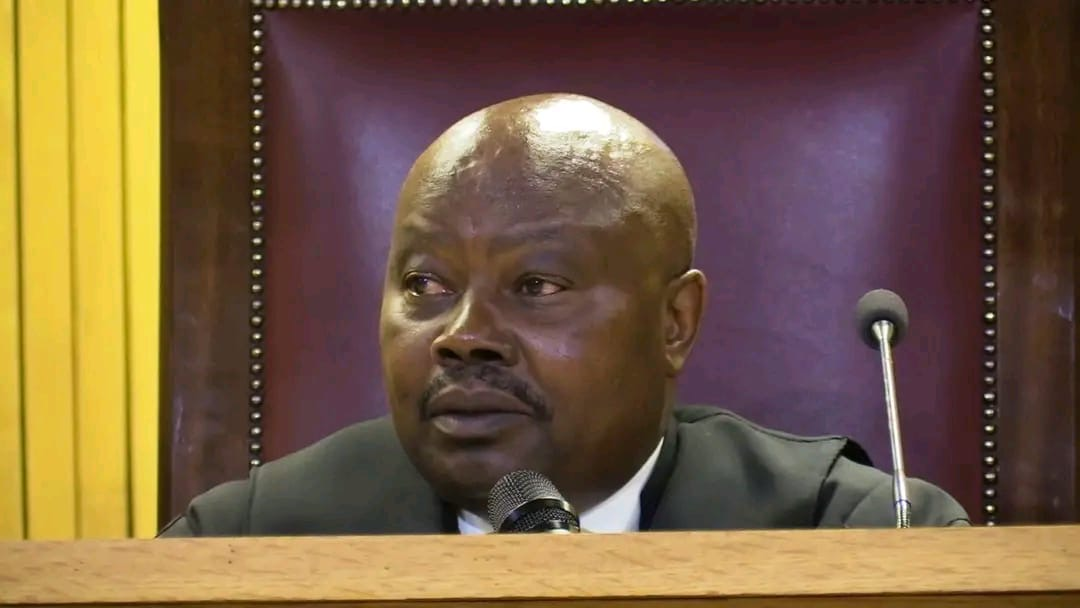
MASERU-A senior member of the Lesotho Mounted Police Service (LMPS) has approached the High Court sitting as the Constitutional Court to challenge a decision by the Director of Public Prosecutions (DPP) to prosecute him for murder.
Senior Inspector Tankiso Lethoko has filed an application arguing that the directive issued by the DPP ordering that he be prosecuted for the death of Ketšepile Moeletsi is unlawful and unfair.
The case arises from events that occurred during a police investigation in Quthing in 2018.
According to court papers, Lethoko was part of a team from Police Headquarters that was sent to assist the Quthing Police in September 2018. The team was deployed following an operational order issued by the Commissioner of Police (COMPOL) after the murder of ‘Mamorolong Morolong and Liseloane Morolong.
The two victims were killed at Pontšeng Ha Mosehle in Quthing, prompting an investigation that involved officers from different police units.
During the course of that investigation, Ketšepile Moeletsi, who was one of the suspects in the killings, died while in detention at the Mount Moorosi Police Station on September 25, 2018.
His death raised serious concerns and allegations soon emerged that suspects who had been detained during the investigation had been tortured by police officers.
As a result, an inquest was opened to establish the circumstances surrounding Moeletsi’s death.
Following the inquest proceedings, it was recommended that several police officers who had participated in the investigation should face criminal prosecution.
However, the Director of Public Prosecutions later issued a directive stating that Lethoko together with a limited number of officers should be prosecuted for the alleged murder of Moeletsi.
The officers named in the directive include Senior Inspector Tshabalala, Sub-Inspector Kikine, Police Constable Sekopo, Police Constable Moshabe and Inspector Nkeane.
Lethoko has now turned to the Constitutional Court arguing that the DPP’s decision is not being implemented in a fair and transparent manner.
In his application, he claims that the prosecution authority has selectively chosen certain officers for trial while leaving out others who were also recommended for prosecution during the inquest.
He argues that this approach raises concerns about discrimination and fairness.
“By focusing on the applicant and a few members of his group as being cherry-picked for criminal trial and leaving aside the other police officers recommended for prosecution, the applicant is apprehensive that the DPP is maneuvering the system to achieve discrimination instead of addressing the demands in the recommendation of the inquest,” Lethoko states in his court papers.
He further argues that the DPP’s actions could violate his constitutional rights if he is prosecuted without being allowed to challenge the directive first.
According to his application, there is a real threat of constitutional irregularity in the way the DPP is exercising her powers under Section 99 of the Constitution.
He says this is particularly important because the directive exposes him to prosecution under Section 31 (2) (f) and (g) of the Penal Code Act No. 6 of 2010.
Because of this, Lethoko argues that he should be given an opportunity to challenge the directive before he is formally remanded and tried.
He says the issues raised in the case are complex and closely connected to the findings of the inquest that investigated the death of Moeletsi.
In his application, Lethoko is asking the court to temporarily stop the implementation of the DPP’s directive.
He specifically seeks an order staying the execution of the directive dated July 8, 2024, which authorised that he be remanded and tried for murder.
He also requests the court to prevent the DPP from filing an indictment against him under Section 119 of the Criminal Procedure and Evidence Act No. 7 of 1981 while the matter is still being considered by the Constitutional Court.
Beyond challenging the prosecution decision, Lethoko is also asking the court to address the role played by senior police leadership during the investigation.
He wants the court to declare that the Commissioner of Police and the Officer Commanding the Quthing Police Station are vicariously responsible for the death of Moeletsi.
In addition, he is requesting that the court order the reopening of the inquest so that the magistrate who presided over it can consider evidence from the Commissioner of Police and the Officer Commanding Quthing Police Station.
According to Lethoko, the inquest did not fully address the responsibility of senior officers who oversaw the investigation.
He further asks the court to declare that the directive issued by the DPP is unlawful to the extent that it conflicts with the powers exercised by the Commissioner of Police under Section 147 of the Constitution.
He also seeks an order reviewing and setting aside the recommendations of the inquest, arguing that they were irregular.
Another key argument raised in his application is that the DPP’s decision to charge only six officers out of a larger group recommended for prosecution is unconstitutional.
He asks the court to declare the decision unlawful because it is inconsistent with Section 19 of the Constitution, which guarantees equality before the law.
Lethoko also claims that the decision to charge him specifically amounts to an abuse of court process.
However, his attempt to have the matter heard urgently has not succeeded.
This week Chief Justice Sakoane Sakoane removed the application from the roll of urgent cases after ruling that it did not meet the legal requirements necessary for it to be heard on an urgent basis.
The decision means that the application may still be heard by the court, but it will proceed through the normal court process rather than being treated as an urgent matter.
The case is expected to attract attention as it raises important questions about the conduct of police investigations, the role of the prosecution authority and the fairness of decisions to prosecute individuals in complex cases involving multiple officers.
The High Court will determine the issues raised by Lethoko once the matter is scheduled to proceed in the Constitutional Court.