



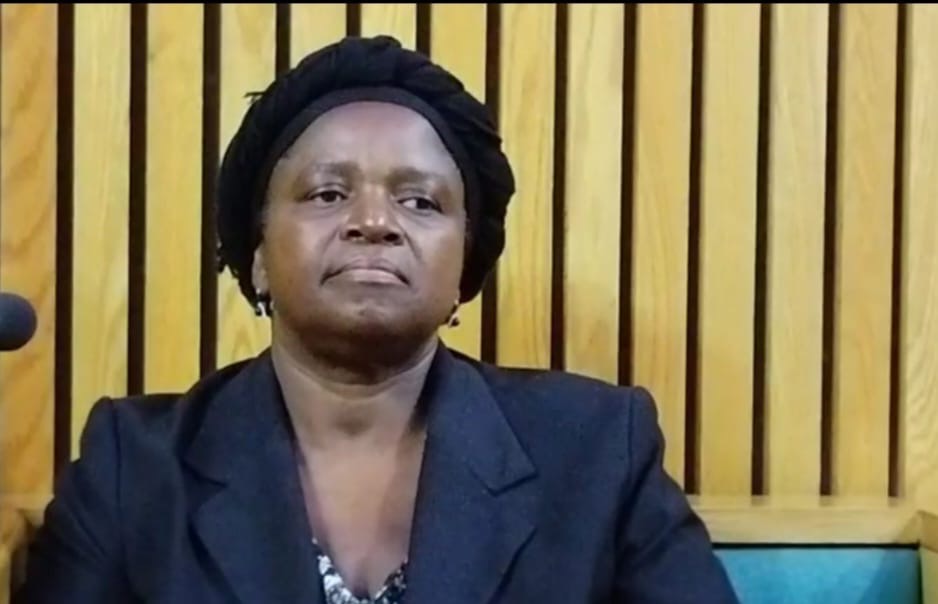
MASERU-Emotions ran high in the High Court this weekas Captain Haleeo Makara described the dull mood that followed the death of former army commander, Brigadier Maaparankoe Mahao. Speaking as both a defence witness and one of the accused, Captain Makara told the court that members of the arrest team “bowed their heads with sadness” when they were informed that Mahao had died at Makoanyane Military Hospital.
The testimony forms part of the defence case in the long-running trial in which nine members of the Lesotho Defence Force (LDF), including retired army commander Tlali Kamoli, stand accused of murdering Mahao. The incident dates back to June 25, 2015, when Mahao was shot at Ha Lekete in Mokema during what the defence describes as a lawful operation to suppress mutiny within the army. The prosecution, however, maintains that the killing was planned and deliberate.
Captain Makara confirmed in court that he was the soldier who fired the shot that struck Mahao. He told the court that the decision to shoot was made in a split second, under intense pressure.
According to his account, the arrest team had approached Mahao’s vehicle as part of an operation aimed at apprehending suspected mutineers. The defence maintains that Mahao was among those considered part of the alleged mutiny plot within the LDF. On the day in question, the team intercepted his vehicle and attempted to arrest him.
Makara testified that Mahao was holding a firearm at the time, posing a danger to Captain Hashatsi, who led the arresting team. Hashatsi was reportedly instructing Mahao to step out of the vehicle when the situation escalated.
“I had to protect Captain Hashatsi,” Makara told the court. “There was no other way I could be able to help him without shooting at the window of the truck. It was impossible for me to go open the window, then come back and shoot.”
One of the central issues in the case has been the manner in which Mahao was shot. Under questioning, Makara explained why he aimed at the right side of Mahao’s body rather than attempting to disarm him by targeting his hand.
He told the court that there was simply no time to aim at a smaller part of the body. “It was going to take me long to aim at the hand because it is one of the small parts of the body,” he said. In the heat of the moment, he believed shooting at the side of the body was the only viable option to neutralise the perceived threat.
Makara also acknowledged that the vehicle in which Mahao was travelling was damaged during the shooting. He described the incident as chaotic and fast-moving, leaving little room for calculated action.
The defence argues that the damage to the vehicle and the fatal shooting were consequences of a lawful operation that went wrong, not evidence of a planned killing.
After Mahao was shot, he was transported to Makoanyane Military Hospital. Makara told the court that when members of the team were informed that Mahao had died, the mood shifted dramatically.
“Our heads were bowed with sadness,” he said quietly.
The statement appeared to underline the defence’s argument that there was no intention to kill Mahao. According to the accused, the outcome was tragic but unintended.
However, the prosecution disputes this version of events. State lawyers argue that the operation was not merely an arrest gone wrong, but a calculated act aimed at eliminating Mahao.
Captain Makara is not the first among the accused to take the stand in his own defence. Earlier in the proceedings, Captain Litekanyo Nyakane, the first accused in the matter, also admitted participating in the operation intended to arrest Mahao. Nyakane told the court that while the mission was meant to apprehend Mahao, it ended in his shooting and death.
The nine accused soldiers face multiple charges. These include murder, attempted murder, theft, and unlawful damage to property. The attempted murder charges relate to others who were allegedly present during the shooting, while the property-related charges stem from damage caused during the operation.
The defence continues to insist that the team acted within the scope of their duties, responding to what they perceived as an immediate threat. The prosecution maintains that the evidence will show otherwise.
The killing of Maaparankoe Mahao on June 25, 2015, remains one of the most controversial and painful chapters in Lesotho’s recent history. At the time of his death, Mahao was widely regarded as a respected senior military figure.
The incident intensified political and security tensions in the country and drew both regional and international attention. Years later, the matter continues to unfold in court, with detailed testimony painting differing pictures of what happened that winter day in Mokema.
For the families involved, and for the nation at large, the proceedings are more than just a legal exercise. They represent a search for clarity and accountability over events that had far-reaching consequences.
Throughout the trial, two sharply contrasting narratives have emerged.
The defence portrays the shooting as a tragic but lawful response during a volatile arrest operation. According to this account, Mahao’s possession of a firearm created an immediate risk to the arresting team, justifying the use of force.
The prosecution, on the other hand, contends that the operation was a cover for a premeditated killing. They argue that the evidence will demonstrate intention and coordination among the accused.
As testimony continues, the court is tasked with examining the credibility of witnesses, the consistency of their accounts, and the forensic and documentary evidence presented.
The matter is being heard before Justice Charles Hungwe, who has presided over the trial as it moves through complex and often emotional testimony.
With several defence witnesses already heard and more expected, the case remains far from conclusion. Each new account adds another layer to an already intricate legal battle. The case is said to continue on 08th day of June 2026.