


MAHOBONG, LERIBE
Lesotho took a definitive step toward food independence.
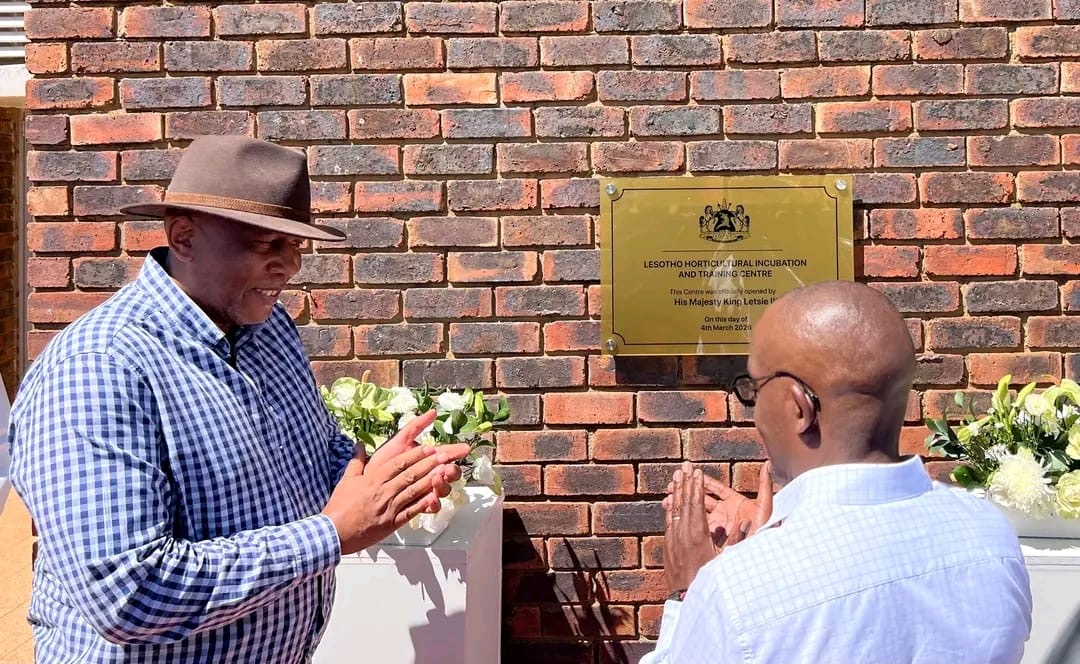
This week, His Majesty King Letsie III appeared not only as the Head of State in Mahobong but also in his international capacity as the FAO Special Goodwill Ambassador for Nutrition, to officially inaugurate the Lesotho Horticultural Incubation and Training Centre.
For the King, the rows of deciduous fruit trees and the state-of-the-art packhouse represent more than just agriculture. They are a frontline defence.
“Our vision must align,” the King noted, emphasising that the fight against hunger and poverty is a national priority that mirrors global goals.
His tour of the orchards and sorting facilities signalled a royal endorsement of a transition from subsistence farming to a sophisticated, commercialised “Agri-business” model.
The atmosphere of the celebrations of the centre was sharpened by a sobering reality check from Daniel Chakela, Vice President of LENAVU and a representative for Lesotho farmers.
Chakela linked the quiet fields of Mahobong to the volatile landscape of global geopolitics and international power struggles.
In a fiery address, he warned that relying on long, fragile supply chains from distant nations leaves Lesotho vulnerable to shocks beyond its control.
“A country that relies on imports will perish if it does not produce on its own,” Chakela cautioned. He issued a direct plea to the Ministry of Trade, Industry and Business, saying “training is not enough as Basotho produce must be guaranteed space on the shelves of the nation’s major retail giants.”
For Chakela, the centre is the engine but secure market access is the fuel that ensures national resilience.
This engine, he said, is powered by the Competitiveness and Financial Inclusion (CAFI) project, backed by the World Bank and a specific $950,000 grant from the IBSA Fund (India, Brazil, and South Africa).
CAFI Project Manager, Chaba Mokuku revealed that the incubation is not just a future promise but a current reality, adding that over 200 small businesses, largely owned by youth and women, have already been successfully incubated through the project.
By transforming farming into a high-value professional career, the centre provides a direct answer to the nation’s high youth unemployment rate.
The goal of the project remains simple: to create a business-enabling environment that simplifies the path for a young entrepreneur to move from planting a seedling to becoming a national supplier, ensuring that the next generation of Basotho sees the land not just as a means of survival, but as a source of wealth.
The King inaugurates the Horticultural Incubation Centre


RELATED ARTICLES